
In this guide to shoe soles, we will examine the various types of sole finishing you can expect to receive at different price points and make-ups, i.e., bench grade vs. hand grade vs. handmade.
There is often much confusion on this topic, so hopefully, we can shed some light on how the different areas should be referred to when discussing modern, production/workshop-made shoes. Let’s take a look!
A Guide to Shoe Soles

Bench Grade Shoes
The term ‘bench grade’ is usually defined as the entry point to Goodyear welted footwear. It’s funny as ‘bench grade’ actually refers to a shoemaker working at his shoe bench. Yet, bench-grade shoes are the furthest thing from a handmade shoe. It is very much a streamlined production shoe with very little detailing put into it. What you are paying for in these shoes is simply the construction method and the leather.
This method is usually accompanied by:
- Open-channel soles (seeing the channel stitch on the bottom of the sole)
- Straight Waists (on the sole’s side edge)
- Flat Waists (on the sole’s bottom, between the forefoot and the heel)
- Natural colored soles (un-colored)
- Straight Heels
Hand Grade Dress Shoes
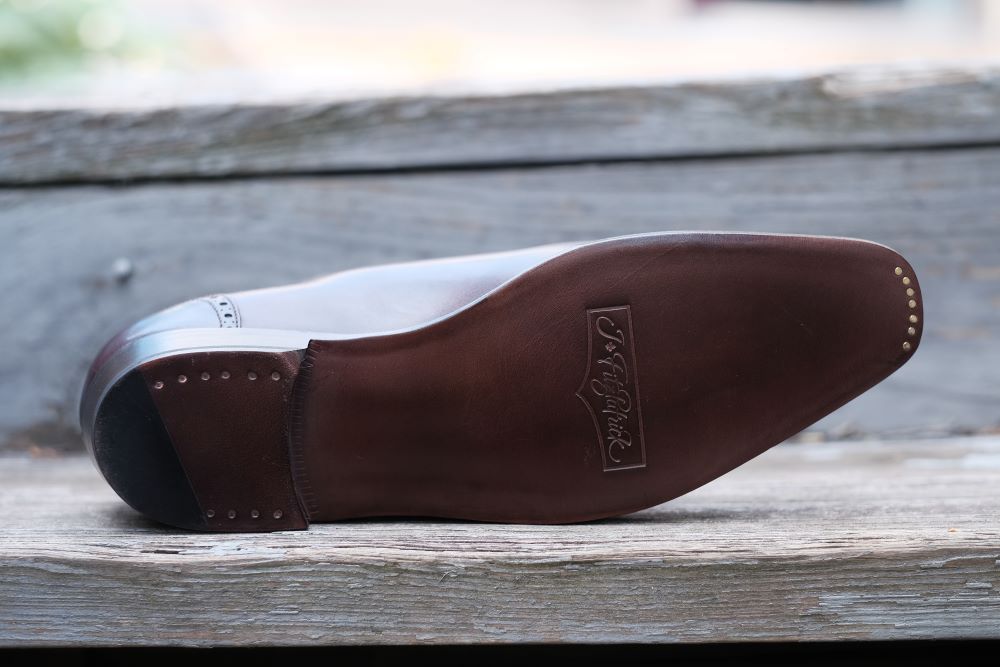
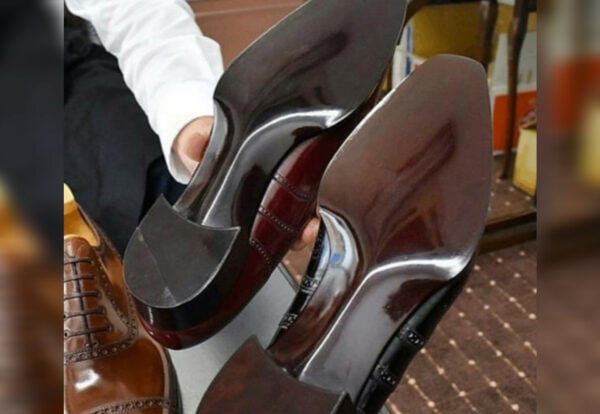
The world of hand-grade shoes is a large one. Hand-grade shoes are usually defined as Goodyear welting shoes that have hand detailing to them. Hand detailing can be a numerous amount of things from hand-lasting the waist of the sole to hand-shaping the waist of the sole to make it more narrow, and to hand-finishing it with edge irons and the like. And that is just the sole. Hand-cutting (i.e. ‘clicking’) the upper would be another feature of a hand-grade shoe. There are many details but let’s focus on what you find in the soles of a hand-grade shoe.
This method is usually accompanied by:
- Closed Channel Soles (where the channel for the sole stitch is covered by a flap of sole leather)
- Beveled Waists (on the sole’s side edge, where they use a tool to ’round out’ the edges of the leather)
- Shaped Sole Waists — not a guarantee, but some hand-grade shoes will make a humped waist, a fiddle back waist etc
- Colored Soles
- Nails in the toe, toe taps, or other detailing hardware features
- Pitched Heels (slanted heels)


Handmade Dress Shoes
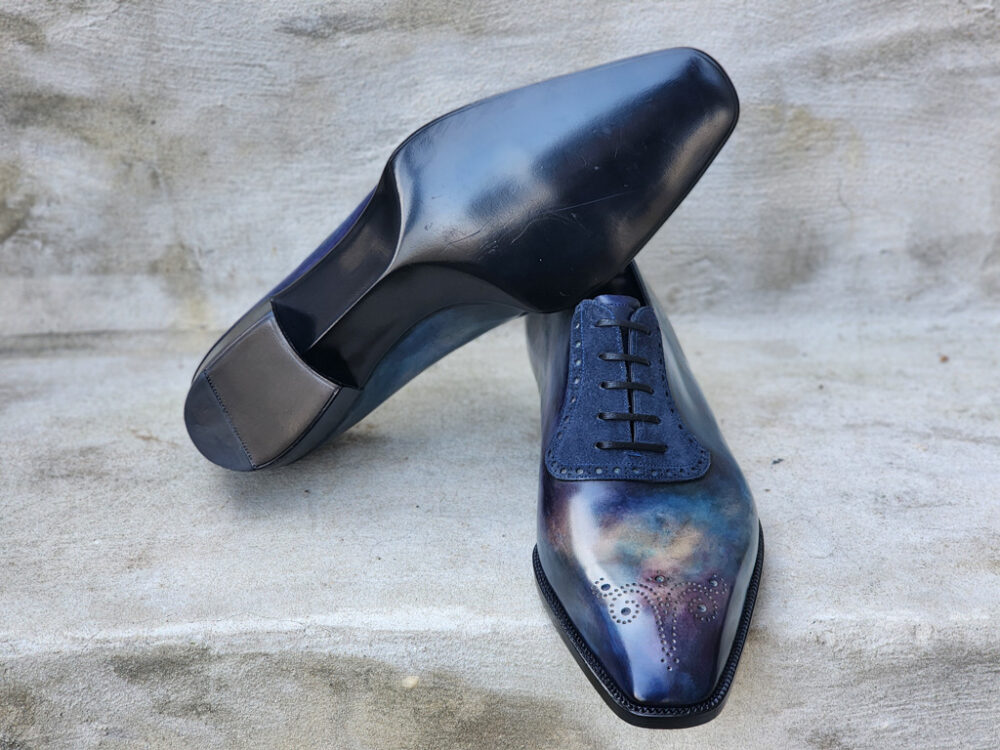
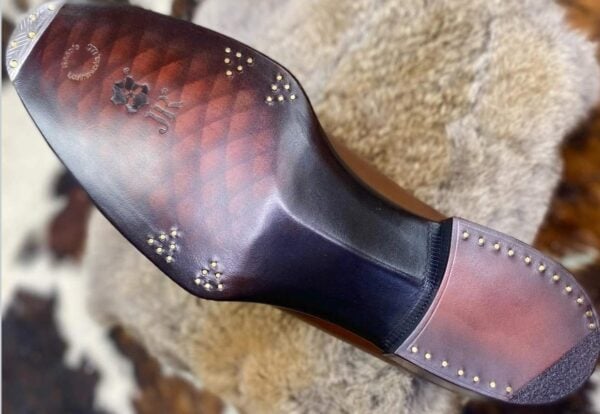
The reality with handmade shoes is that you can get any look stated above. I have seen very basic handmade shoes to the most extravagant ones. You get the best of all worlds, depending on how you like your shoes. But more often than not, someone actually making the shoes by hand will put all of the bells and whistles to show the fact that the shoe was in fact handmade. It’s a point of pride and the shoemaker often goes above and beyond to make those details unmistakably defined.
This method is usually accompanied by:
- Closed Channel Soles
- Longer Beveled Waists
- Shaped Sole Waists
- Pegged Waists
- Colored Soles
- Nails in the toe, toe taps, or other detailing hardware features
- Pitched Heels (slanted heels)
- Shaped Heel Blocks
- Fudging on the welt (where there are jagged indentations over the sole stitch)
- Decorations on the sole – from designs to patina’s and the like
- More narrow sole waists as they will shape the waist before adding the sole and trimming it as close to the last as possible


I hope that you have enjoyed this guide to shoe soles. The video will show more of the details described in the post so please do check that out.
And if you have yet to subscribe to my YouTube channel, please do so. Thank you!
—Justin FitzPatrick, The Shoe Snob
Shop · Marketplace · J.FitzPatrick · Patreon






Interesting. I had no idea there were so many differences.
Glad that you enjoyed
Delightful way to spend 13 minutes. Thank you .
Glad to hear it Matthew, thank you for saying so
Wonderful lesson thank you justin
My pleasure Keith, glad that you enjoyed it
Well explained .Thank you for sharing this .
My pleasure
Justin, you do excellent work educating others about shoes and appropriate dress in a world that increasingly favors casual wear. I refuse to conform to this behavior. Thank you again for your work.
Stephen
I appreciate your kind words Stephen. Thank you for saying so. Keep up the good fight 😉