

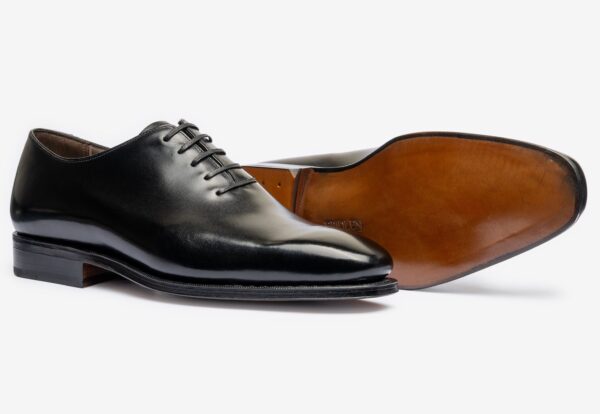
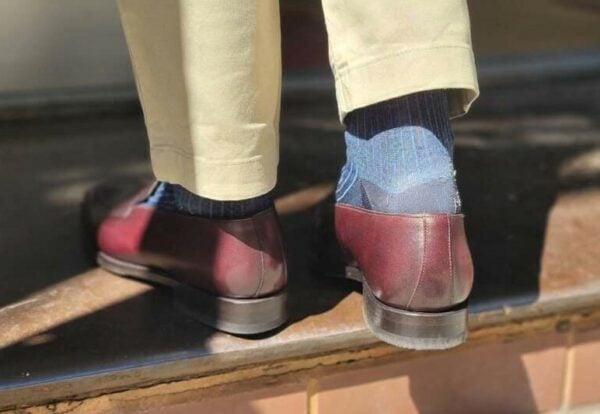
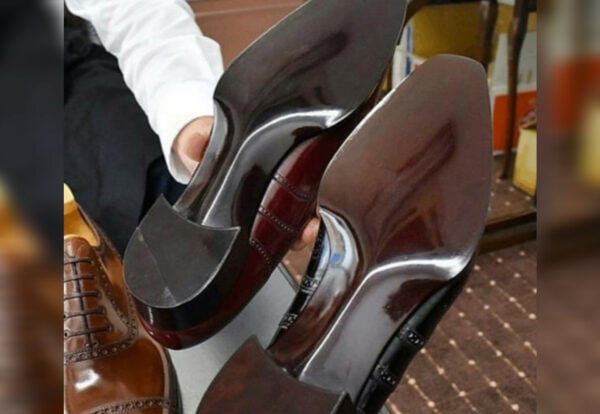
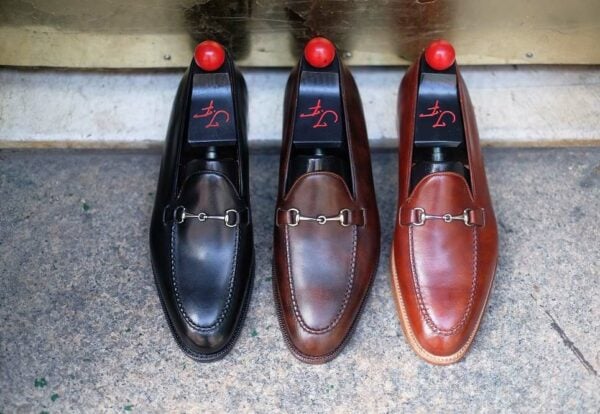
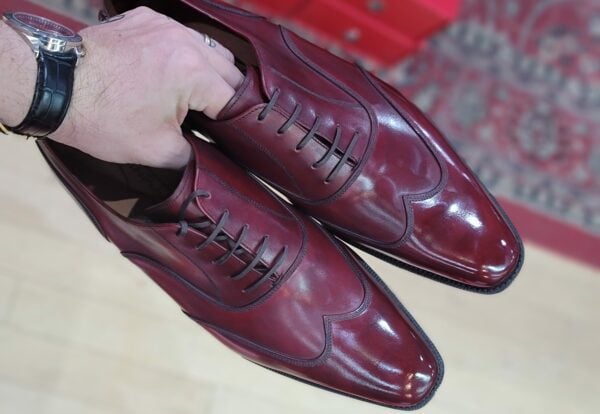
The 360° leather channeling by Bridlen is an impressive feature on shoes that retail below $300. It even makes one think about how ‘expensive’ and/or rare these machines are if a manufacturer that retails that low offers that feature. And it is definitely a feature that raises the overall impressiveness of Bridlen and to one degree a reason that many are seeking them out.
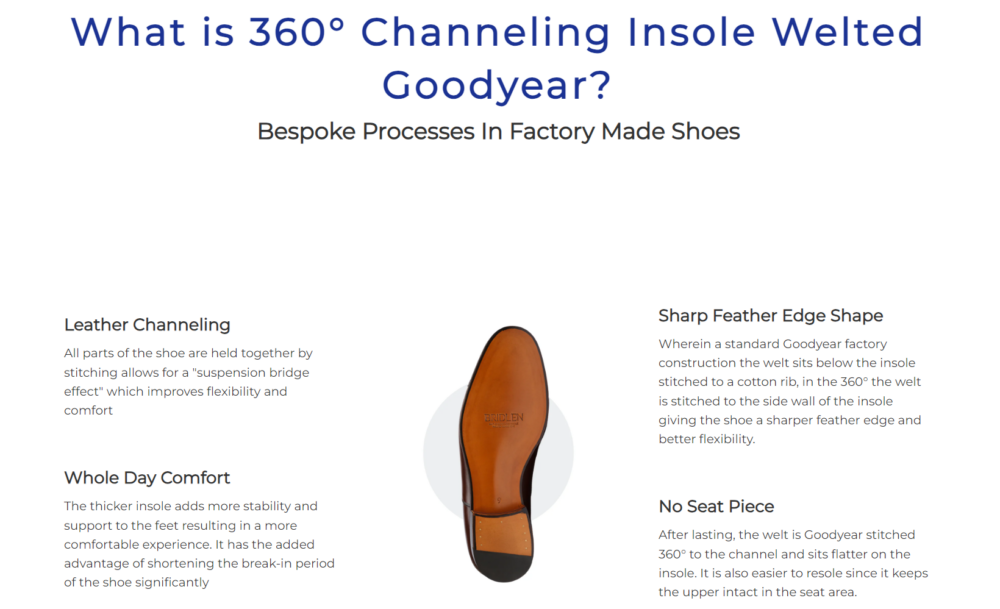
There has been a long debate in the industry on the process of gemming and whether it renders a shoe inferior or not. The bespoke shoemakers, will, of course, say that it does. And rightfully so in their case. However, the welted shoe industry has adopted gemming as a common practice for ‘efficient’ (some might say ‘cheaper’) shoe production and is used by some of the top shoemakers in the world. Those shoes are widely considered among the top of the industry and the highest quality for production-made shoes.

Therefore, to say that it is inferior by a large margin has always been, in my opinion, an overkill statement. But, that doesn’t mean that I feel using the real thing is not superior. The 360° leather channeling by Bridlen is the real thing. Before Bridlen, it was used by very few production-style manufacturers, including JM Weston (of France) and those who made hand welted shoes.

The debate on which method is better is a tiring one and not the intention of the post. The intention is to say that it is impressive that Bridlen continues to offer these quality features on shoes priced so low, relatively speaking. If you have yet to learn about Bridlen shoes, I highly suggest reading more about them here. Particularly watching my unboxing videos where you can see how they have impressively gone from entry-tier shoemakers to a force to be reckoned with.

The 360° leather channeling by Bridlen is something to acknowledge as it shows that 1. It can be done by larger manufacturers and 2. Gives us the ability to test its longevity, and lastly 3. Might start to set a precedent for future manufacturers, and even existing ones, as something to aspire to. One could argue that point 2 could have already been done, but I beg to differ as the argument historically has always been done comparing apples and oranges i.e. a bespoke shoe to a $400 welted shoe.

The guy who owns bespoke shoes is probably not wearing them the same as the guy in $400 dress shoes. But a guy buying $250 Bridlen shoes is probably entering this industry and will wear them a lot. That will be able to show how many re-soles he can go through which was always the argument’s line drawn: ribbed shoes fall apart. Either way, it is great to see this on production-style shoes and I do hope that other makers follow suit.
Do continue to watch Bridlen as they gain traction in this competitive industry. I assure you, they will rise.
If you happen to be in NYC this weekend or close to it, make sure to come see them in person at the NY Super Trunk Show, this October 5th. Learn more here.
Learn more about Bridlen here: https://bridlen.com/
—Justin FitzPatrick, The Shoe Snob
Shop · Marketplace · J.FitzPatrick · Patreon
***Bridlen is a sponsor of The Shoe Snob Blog and you can consider this a sponsored post***






I believe Viberg, the boot makers out of Victoria, Canada, also use this method of machine channeling the insole.
Another west coast Canadian shoemaker, HD Russell, actually specifically avoids such methods because (from what I’ve heard), gemming is less damaging to the structural integrity of the leather insole. What do you think of this Justin?
Thanks for sharing Steven, good to know re Viberg.
As per the other claim, that depends on how thick the insole is cut. IF a gemmed insole is 3mm but a cut one is 5mm then chances are there is not a structural worry. But if the cut one is 3mm then yes, it plays on the verge of becoming too thin. So the maker has to make sure that the insole used is sufficient for using this method.